
TriBar TechnologiesTriBar Energy · Research Division
Chapter I · page 2 of 12Research
Research

Better anodes start at the atom.

Lithium-metal batteries could store far more energy than today's cells, but lithium plates unevenly and grows dendrites. Gold helps, but gold is costly. Our work asks how little gold you need, and what structures lithium and gold form together.

Why this work

The problemA lithium-metal anode can hold about ten times more charge per gram than the graphite in today's cells (3,860 against 372 mAh/g). But lithium plates unevenly. It grows needle-like dendrites that waste lithium, shorten battery life and can short the cell.
Our approachGold seeds make lithium plate smoothly, but gold is expensive. Before anyone builds a cell, we use quantum-mechanical calculations to ask what lithium and gold actually form together, and how little gold the job needs. Every expected result is written down before the calculation runs.
The goalAnodes that store more energy, last longer and cost less, made by processes that are safe to scale. It is one part of a larger aim: new materials for a world whose resources are being stretched.

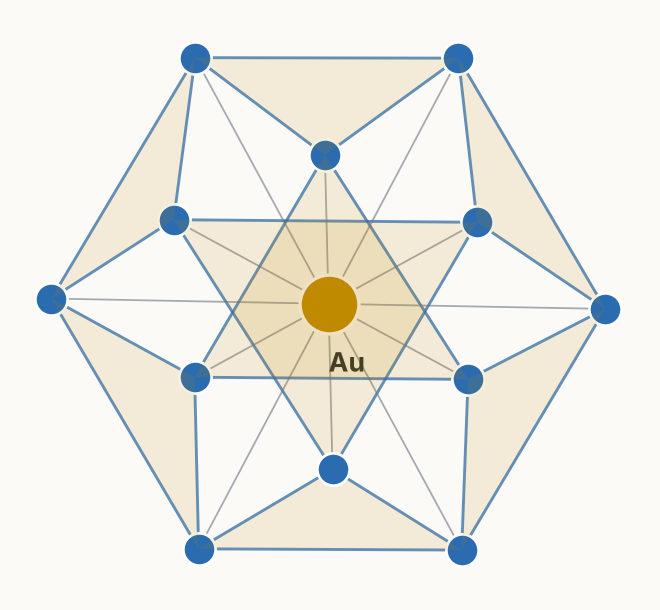
The J phase (Li₈Au)

Each gold atom sits inside a cage of 12 lithium atoms. All of its vibrations are stable, it survives room-temperature simulation, and it lies only 8.9 meV per atom above the most stable mix, close enough that it could form under battery conditions.

ΔHf(Li₈Au) = [E − 8μLi − μAu] / 9

Preprint v1, Oct 2026: doi:10.5281/zenodo.23569302 · in revision for journal submission

Gold–zinc seed layers

A thin gold–zinc film on copper foil, made by a cyanide-free wet process, aims to give gold-like lithium plating with far less gold. Our calculations test how strongly lithium binds to gold–zinc before any cell is built. Our first structure met 4 of the 5 predictions we wrote down before the run.

Eins(Li) = E(LiAu₂Zn₂) − E(Au₂Zn₂) − μLi

Calculated: dynamically stable · lab validation planned

What we are doing now · October 2026

PublishingThe J phase (Li₈Au) paper is public as a preprint with a DOI and is being revised for submission to a peer-reviewed journal. Our dark-energy forecasts (doi:10.5281/zenodo.23623208) and analysis code (doi:10.5281/zenodo.23648261) are also public on Zenodo.
CalculatedVibration (phonon) calculations show our gold–zinc–lithium structure is dynamically stable: every vibration mode is real, with none pulling the structure apart. Calculations for a second Li₈Au ordering show it is also dynamically stable: both ways of arranging the gold are stable.
NextLaboratory tests of gold–zinc seed layers on copper foil, and a partner to cycle real lithium cells. Research partners and investors are welcome: see Contact.